
Opening the data lens
When specification sheets promise a CRI number, they’re usually talking about a photometric lab snapshot — a controlled test that says how faithfully colors render under a light source. A data-driven approach asks the next question: how stable is that CRI when fixtures move from the bench to a pier mount and then endure wind, salt spray and seasonal temperature swings? Early field reports and municipal maintenance logs show that perceived color fidelity on facades can shift over months, so practitioners should monitor both initial CRI and its trajectory in situ. Practical products such as the outdoor wall lights motion sensor family factor into these considerations because real installations often combine fixture performance with control systems that affect driver current, dimming profiles and thermal loading.
What CRI means in the real world
CRI — the CIE-defined index that runs from 0 to 100 — measures how closely a light source renders a set of reference colours compared with a standard illuminant. It’s a useful single-number shorthand, but it hides spectral nuances. Two LEDs with the same CRI can still render skin tones or architectural pigments differently if their spectral power distributions (SPD) diverge. In outdoor facade work, that matters: the way a historic stone surface appears under a pier-mounted luminaire will depend on both CRI and the SPD curve, plus the local viewing angles and the interaction with ambient lighting (street lamps, storefronts).
Why lab stability and field stability differ
Labs control temperature, humidity and electrical input to get repeatable CRI readings. Once mounted on a pier or building face, variables multiply: driver temperature rise, reduced heat-sinking on enclosed housings, ingress of salt and dust, and dimming behaviour from networked lighting controls. These factors influence LED junction temperature and current regulation, which in turn shift spectral output and therefore CRI. For procurement teams this gap means one-time lab certification isn’t enough — long-term monitoring is essential.
Real-world anchor: urban façades and event lighting
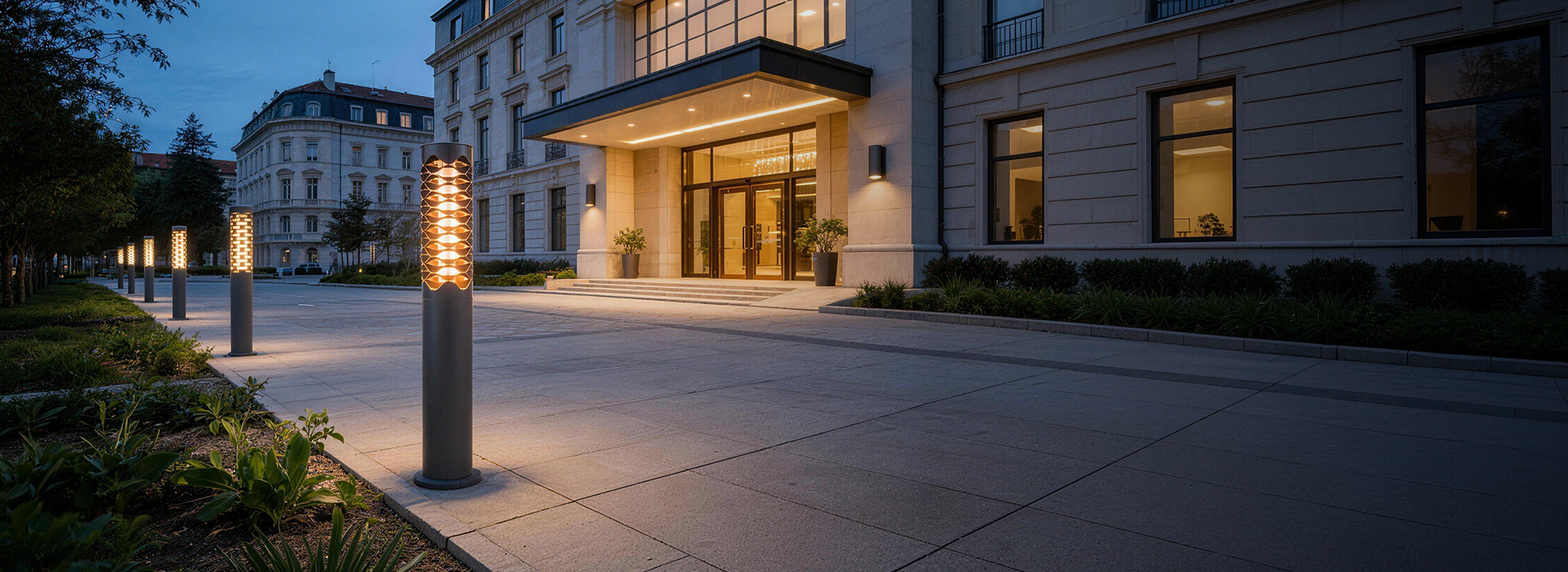
Consider large civic facades frequently relit for events — for example, Toronto’s CN Tower and surrounding civic buildings that use LED façade systems for celebrations. Those systems are exposed to weather and variable control strategies during events, and facility managers routinely report perceptible colour drifts after several seasons. That anecdote aligns with broader municipal data showing that maintenance cycles and firmware updates often correlate with restored colour consistency on large-scale LED installations.
How to measure CRI stability: practical metrics
Beyond initial CRI, track a small set of measurable indicators on an ongoing basis: spectral shift (using a compact spectrometer), correlated color temperature (CCT) drift, and luminous flux degradation (lumens). Combine periodic SPD snapshots with logged driver current and junction temperature readings. These three metrics tell you whether a change in appearance stems from spectral shift or simply lumen depreciation — and they’re easier to collect now thanks to compact sensors and networked control systems.
Common failure modes and mitigations
Typical problems are thermal runaway, moisture ingress and control-system artifacts. Thermal issues alter LED bin characteristics; moisture corrodes contacts and changes the electrical path; and dimming protocols can drive LEDs into spectral regions that lower perceived CRI. Mitigations include specifying higher-quality LED bins, robust IP-rated housings, and smart drivers with temperature compensation. For pier mounts on maritime piers, choose housings and gaskets rated for salt-laden air and allow for scheduled thermal inspections — they’re inexpensive preventive actions that save repainting and relamping costs.
Installation and control strategies that preserve colour
Prioritise fixture placement and luminous intensity so that multiple sources blend softly across a façade rather than creating hot spots that accentuate small spectral differences. Use control strategies that avoid extreme low-end dimming unless the driver provides spectral-preserving dim curves. Integrating testing into commissioning — measuring SPD and CCT at 0, 50 and 100 percent output — gives you a baseline and a clearer warranty claim if things drift. Also consider systems marketed as led building facade lighting that specify spectral stability over operating life; those specifications can be a good procurement filter.
Maintenance, monitoring and procurement playbook — a data-driven checklist
1) Require SPD and CRI stability specs for at least 5,000 hours of operation in supplier documentation. 2) Specify periodic spectral checks (e.g., every 6–12 months) and include them in SLA language. 3) Insist on driver temperature and current logs accessible via the control system so you can correlate spectral shifts with operating conditions. These measures convert lab claims into field confidence.
Advisory: three critical evaluation metrics
1) Spectral Drift Tolerance — define acceptable SPD change (e.g., allowable nm shifts or Δuv thresholds) rather than only a point CRI. 2) Thermal Management Score — assess fixture thermal resistance and driver temperature compensation to predict long-term spectral stability. 3) Control-Path Integrity — verify that dimming and motion-control strategies (including any outdoor wall lights motion sensor interactions) do not force LEDs into spectral regions that lower CRI. Choosing suppliers who publish these metrics and back them with field data reduces surprises and warranty friction.
When you tie these practices together you move from reactive repainting and relamping to predictive performance management — and that’s where long-term value lives. Keyida helps bridge lab-quality specifications with real-world installation practice, making durable colour fidelity an achievable outcome. Think performance-first.