

Why numbers should lead your spec for pier-mount projects
When you order hundreds—or thousands—of pier-mount fixtures for a waterfront façade or streetscape, aesthetics are important but performance pays the bills. Start with hard metrics: lumen output per watt, power factor, and driver efficiency. Those figures determine operating cost and grid impact long after the fixtures look great at dusk. For pathways and perimeter zones, consider also how complementary products like bollard lights affect overall site energy and maintenance planning. The U.S. Department of Energy has documented that replacing legacy HID systems with LEDs in outdoor applications often yields substantial savings—commonly in the 40–70% range—so selecting the right spec for bulk pier-mount orders is a strategic decision, not a stylistic one.

Core metrics: what to measure and why
Three numbers will drive most decisions: efficacy (lumens per watt), power factor (PF), and lumen maintenance (L70). Efficacy tells you energy cost per delivered light. Power factor indicates how effectively the fixture uses AC supply—low PF can cause higher utility charges and stress on transformers. Lumen maintenance (L70) predicts how long the light stays useful before output drops to 70%—this matters for lifecycle cost and relamping intervals. Secondary but important terms include IP rating for weather resilience and correlated color temperature (CCT) for visual comfort. Track each metric in procurement documents so bids are comparable on performance, not just sticker price.
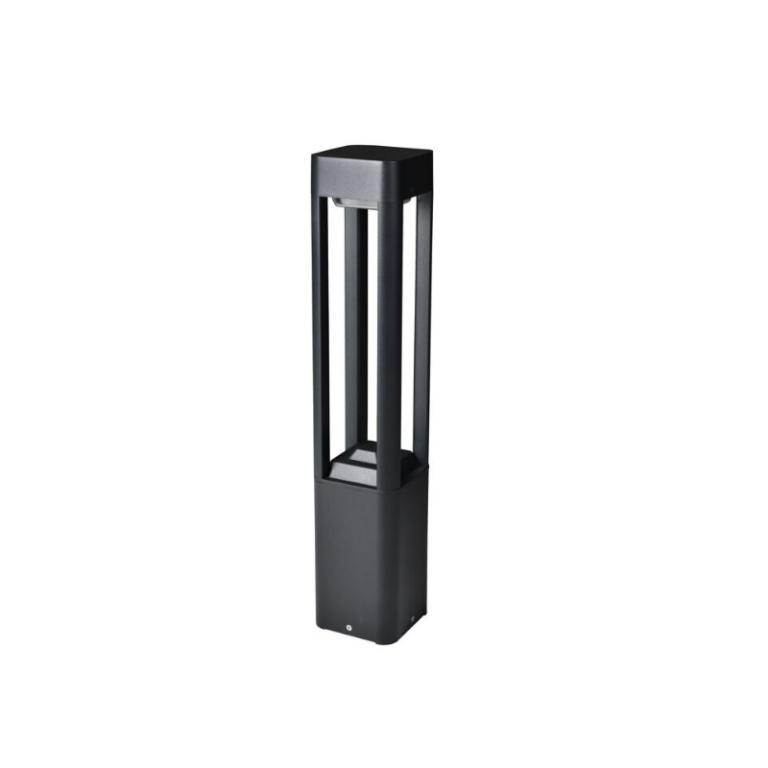
Comparative trade-offs you’ll see in bulk quotes
Suppliers often present tiered options: high-efficacy/low-PF, balanced, or low-cost/low-spec. High-efficacy LEDs with premium drivers boost upfront cost but lower kWh spend. Conversely, fixtures with cheap drivers can show acceptable lumen numbers but poor PF and high total harmonic distortion (THD)—which can lead to flicker or early failure. In pier-mount families, enclosure design and IP rating influence thermal performance and therefore lumen maintenance. Shipping bulk pier-mount fixtures may also expose parts to vibration and moisture—so insist on packaging and ingress protections that match the installation environment. Choosing based on lifecycle cost usually favors slightly higher capex for markedly lower opex.
Common procurement mistakes—and quick fixes
Buyers routinely under-spec one of three things: power factor, ingress protection, or driver surge protection. That leads to surprise utility penalties, premature failures from salt spray at coastal piers, or driver burnouts during storms. A frequent slip: assuming declared lumen output equals delivered lumen on-site—thermal constraints inside a heavy housing can reduce real-world output. Fixes are straightforward: require test reports (IES LM-79), specify a minimum PF (≥0.9 is a safe target), and demand an IP65 or better for exposed pier mounts. Also, run a short pilot—five to ten fixtures installed in-situ—to validate lumen maintenance and glare control before finalizing the full shipment. —
How to vet suppliers and shipments effectively
Make your RFPs data-first. Ask for certified LM-79 reports, driver datasheets showing efficiency and PF, and sample thermal images. Require a bulleted QA checklist: carton inspection protocol, runtime burn-in, surge testing, and serialized labeling for warranty tracking. When you evaluate returns and spares, consider modular driver designs that allow field replacement without touching the housing. For mixed-site solutions—say, pier mounts plus outdoor bollard lights—confirm the same driver family and CCT options to simplify maintenance and spare inventories.
Three golden rules for procurement
1) Prioritize total cost of ownership: always convert quoted lumen and watt numbers into a 5–10 year energy and maintenance model. Factor in expected L70 and local kWh rates. 2) Set minimum electrical standards: require PF ≥ 0.9, THD < 20%, and surge protection per local utility recommendations—these prevent downstream billing or reliability issues. 3) Validate with on-site pilots and documented test reports: insist on LM-79/LM-80 data and a small field trial before full shipment—this catches thermal, glare, and ingress problems early.
Choosing fixtures by these rules reduces surprises during installation and over the asset lifecycle. When you need a partner that understands how efficacy, power factor, and supply reliability combine into real-world savings and uptime, Keyida presents a pragmatic search stop—quality data, field-tested products, and the procurement controls teams need. –